
Volnewmer vs Thermage: 115 W vs 400 W at the Same 6.78 MHz
Four hundred watts and 115 watts. Those two figures sit side by side in the comparison table of FDA 510(k) summary K240248, one column for the predicate device Classys named to establish substantial equivalence, the other for the device under review. The predicate is Thermage FLX. The subject device is Volnewmer.
The operating frequency column reads 6.78 MHz for both. Tip sizes match too, at 0.25, 3.0, 4.0 and 16.0 square centimeters across the board, and both interfaces are described as LCD touchscreens. Regulatory classification lands in the same box as well: 21 CFR 878.4400, product code GEI, a Class II electrosurgical device.
Three rows break the symmetry. Maximum output splits 400 watts against 115. Cooling method splits R-134A refrigerant gas against water cooling. And the indications for use diverge: Thermage FLX lists both dermatological and general surgical procedures, while Volnewmer’s entry is narrower, limited to soft tissue electrocoagulation and hemostasis in dermatologic procedures.
What the cooling medium does to pulse length
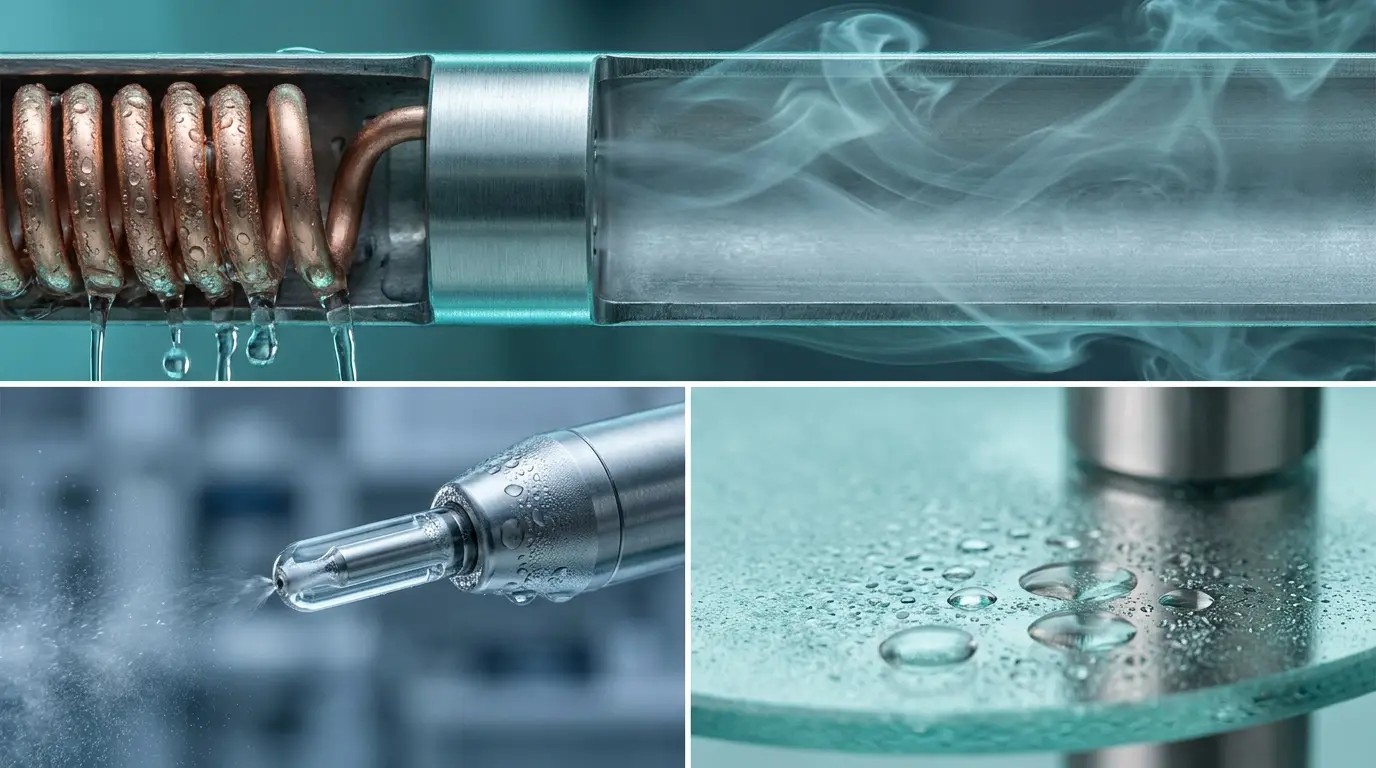
Monopolar radiofrequency works by running current from a single electrode to a return pad, generating heat wherever tissue resists that flow. Volnewmer’s component list reflects that architecture: a console, two handpieces, treatment tips, and a return pad with cable. Because the goal is to raise the dermis to coagulation temperature while sparing the epidermis above it, every device in this category needs some way to manage heat at the surface.
Where Thermage FLX relies on refrigerant gas, Volnewmer circulates chilled water through the tip itself. The manufacturer’s spec sheet lists a unit weight of 56 kilograms, a figure that includes the cooling water, and power consumption of 1200 VA. The treatment sequence follows a set order: place the tip on the skin, confirm impedance, activate cooling, then deliver energy.
The difference in pulse length doesn’t come from either regulatory filing — it shows up in a clinical paper’s own description of the two devices. According to that account, Volnewmer delivers a single 1000-millisecond pulse per application, while the gas-cooled device splits delivery into repeated 200-millisecond pulses. The same paper’s author adds that the split delivery causes more pain. That’s a clinician’s observation recorded in one paper, not the outcome of a head-to-head trial.
A tip that tucks the electrode inward
The manufacturer describes its Hidden Edge design as a structure that removes energy concentration at the electrode’s border. The electrode’s rim sits recessed inside the tip housing, and the tip’s corners are lifted slightly so they never make contact with skin.
The tip head itself is curved and angled to follow the contours of the face. A clinical paper adds a further detail: a cushioning function meant to keep pressure consistent across the treatment area. Tips come in four sizes for four purposes — 0.25 square centimeters for the eye area, 3.0 for the jawline, 4.0 for the face generally, and 16.0 for body treatment.
What the 510(k) comparison table actually verifies stops at those area figures. The table confirms that all four sizes match Thermage FLX, but curvature and edge geometry aren’t line items it covers. The resistance range of 75 to 400 ohms and the rated output of 115 watts likewise come from the manufacturer’s spec sheet, not from the regulatory filing.
What a 3D scanner recorded in 45 patients

A clinical paper describes treating 50 patients, ages 35 to 88, with the 4.0-square-centimeter V-tip for 200 to 300 shots. The default setting was level 5, 115 joules, or 28.75 joules per square centimeter, with a sliding technique used when patients reported heat: the operator would drop a level or move the tip 1 to 3 centimeters. Forty-five patients completed one-month follow-up; their average age was 45.7.
Mean roughness score fell from 16.71 before treatment to 11.88 immediately after, a 28.42 percent improvement. At one month it measured 12.33, holding a 26.23 percent improvement over baseline.
The split isn’t in the averages — it’s in the distribution beneath them. Sixteen patients who were under 40 or started with a roughness score below 10 kept improving between the immediate and one-month readings. Thirty-five patients who were 50 or older, or who started above 10, tended to drift back toward baseline by the one-month mark. The protocol also included stem cell culture medium and occlusive dressing, and there was no control group. What the radiofrequency contributed on its own, and whether results hold past six months, isn’t something this paper establishes.
The condition under which a shot doesn’t count
The 510(k) summary lists Volnewmer’s tips as single-use or reusable. On a device where treatment counts are tracked per tip, how a single shot gets counted has a direct bearing on the cost of running it.
The author of the clinical paper writes that when skin contact is incomplete, Volnewmer halts energy delivery with a warning, and that an interrupted delivery like that isn’t counted as a completed treatment. In the same sentence, the author notes that on Thermage, Tenthera, and Oligio, an interrupted delivery still counts toward the treatment total.
The manufacturer’s product page goes only as far as describing the sequence — the tip checks impedance automatically, activates cooling, then delivers energy. How the shot count itself is handled doesn’t appear there, and it doesn’t appear in the 510(k) summary either.
What the 510(k) settled, and what it left open
The evidence the summary cites for substantial equivalence is entirely nonclinical. The list includes electrical safety and EMC testing under IEC 60601-1, 60601-1-2 and 60601-2-2, biocompatibility testing under ISO 10993-1, thermal effect and in vivo safety testing, bench testing, and software verification at the enhanced documentation level. It is not a filing that reviewed wrinkle-improvement data.
The same table lists a reference device, VirtueRF, alongside the predicate and subject devices: frequency of 0.5 to 2 MHz, maximum output of 220 watts, and water cooling — the same cooling label attached to Volnewmer. Sharing that label doesn’t mean the three devices deliver comparable cooling performance.
The manufacturer’s page lists both US FDA and Korean MFDS clearance together. What K240248 actually confirms is the US indication language; the intended-use wording for the Korean clearance sits in a separate record. Where the coagulation volume produced by a 115-watt water-cooled device overlaps, in tissue depth, with a 400-watt gas-cooled one — that comparison doesn’t appear in any document currently public.
Entities covered in this article
Sources checked
Scope — This article explains devices and technology. It does not provide individual diagnosis or treatment advice.